Image credit: © 2023 Netflix, Inc.
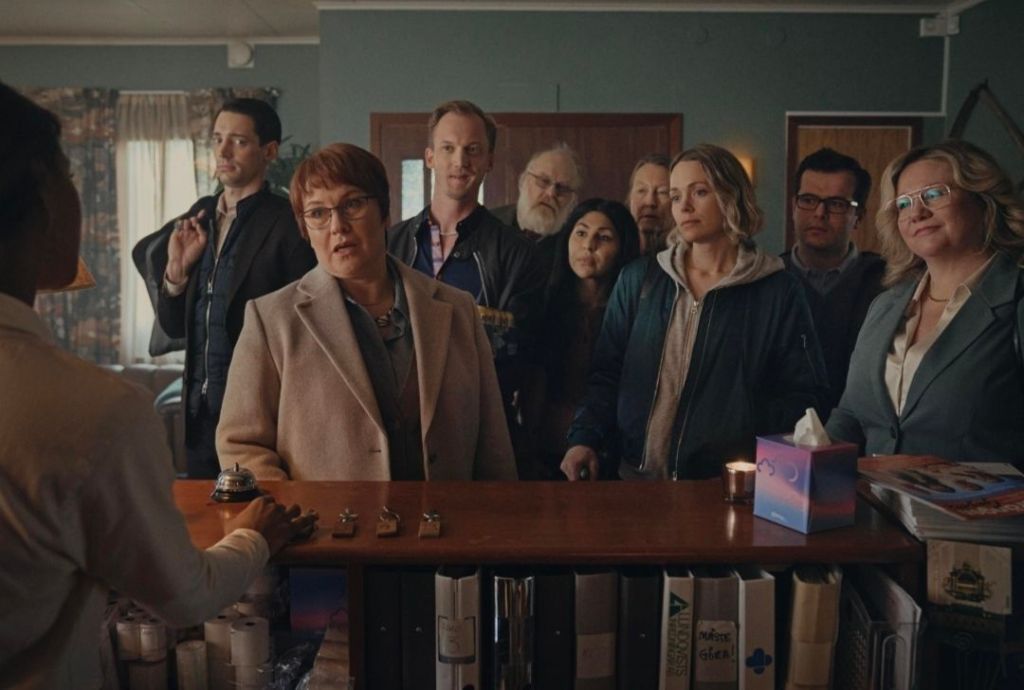
The darkly entertaining, horror-comedy-slasher combo Swedish film ‘The Conference’ (directed by Patrik Eklund) ran with an axe onto our Netflix homepages in late 2023. A success in Sweden, it was also hailed as a brilliant but wry cinematic venture in many other countries, topping the non-English language film list in October 2023 (source: Netflix).
A movie adaptation of Mats Strandberg’s novel Konferensen, the film was widely praised as a dry-humoured but fun watch, particularly concerning its satirical take on Swedish office culture and, of course, every employee’s favourite thing – team-building retreats. Whilst some viewers thought that the film used many traditional slasher clichés as a crutch, I thought it was an incredibly unique idea.
But nothing was quite as unique to me but the characters of project leader Jonas (Adam Lundgren), and his apparent sidekick/hypeman, Kaj (Christoffer Nordenrot). Whilst the film was full of talent – including the likes of Katia Winter and Maria Sid – it wasn’t just the two mens’ acting that stood out to me, but more what their characters seemed to symbolise.
Today, I’m going to crucify Jonas. Kaj will have his own article, but more focused on avian imagery than the religious throes of the Book of Jonah.
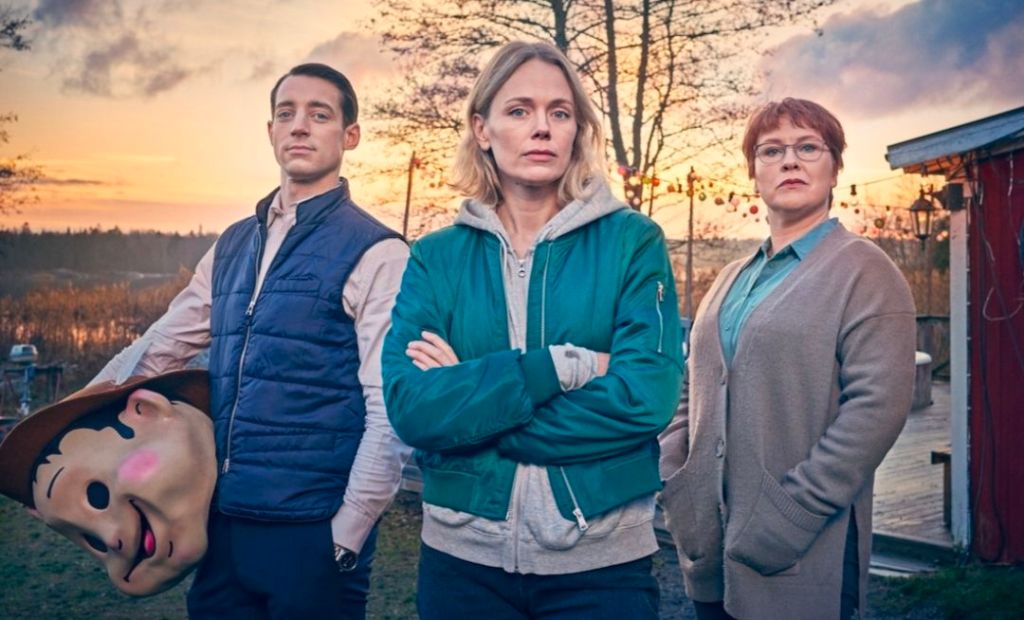
Image credit: © 2023 Netflix, Inc.
Adam Lundgren’s Jonas portrays a twisted, pointed caricature of the worst project leader you could ever hope for. Clinically manipulative, no word that Eklund (and Thomas Moldestad) wrote for this character is wasted. He clearly thinks he’s on top of everyone else, from talking down to co-worker Lina (Katia Winters herself) to shoving everyone else out of the way – literally – when the masked killer starts rampaging through the holiday retreat woods. Lundgren’s performance is enough to make you want to punch a hole through your screen just to get Jonas to wipe that smirk off his face.
I would like to point out that Jonas, as a name, is derived from ‘Jonah’, to make my main point when it comes to references and symbolism in this slasher-on-the-surface film. If you are not familiar, the Book of Jonah is a part of the Old Testament Bible.
The story goes, that Jonah is a reluctant prophet who is meant to go to Nineveh (the capital of Israel’s enemy state, Assyria) to tell them of their destruction, as commanded by God himself, but then boards a boat to go to Tarshish (which is a rich port town in the opposite direction; Jonah 1:3) to keep himself safe. A violent storm rocks throughout the sea, and Jonah ends up overboard. God, to teach Jonah a lesson, provides a giant fish to swallow him for three days and three nights, before vomiting him onto dry land. Jonah, having prayed to God for forgiveness concerning going to Tarshish whilst inside the fish, begins his journey all over again, and properly heads to Nineveh this time (after the fish throws him up onto his home turf).
Jonah does what he’s told, and tells the Ninevites and their king about their imminent destruction. Surprisingly, the residents repent for their sins. Jonah, thinking nothing of it, goes to sit on a hill to watch the wrath unfold. Nothing happens, as the Ninevites repented and heeded the message. The story so ends by Jonah complaining to God, and God telling him that people basically flourish by following the (His) rules – instead of rejoicing, Jonah is angry that God showed mercy to the Ninevites, whom he considered enemies.
So, now you’re probably asking – ‘but what does that have to do with this entitled project manager’? Let me tell you. I didn’t get a nine in GCSE English literature for nothing.
The Conference, if you didn’t already know, is about a group of municipal workers who are literally a day away from groundbreaking the area that their shopping mall is going to be built on (Kolarängen). The main issue is – this is an extremely rural area. Farmers make their livings there (especially one called Pålsson – we’ll come back to him later). Think of the farmland as Nineveh in this scenario.
We learn that, in one of the team meetings, Jonas and the rest of the Kolarängen crew (par Lina, willingly) have signed the farmland deeds for far less than they should’ve done (‘the land is worth more than you sold it for’ says Lina, much to Jonas’s annoyance). And this isn’t just any old farmland. This farmland belonged to Pålsson (mentioned above). Also, unbeknownst to most part of the team, Jonas – alongside Kaj – has been in direct contact with rival contractors, a company named Backmann-Kroon.
They (Jonas and Kaj) do not care about the farmlands (this scenario’s Nineveh). The Ninevites are protesting. Torbjörn (Claes Hartelius) and Annette (Cecilia Nilsson), the office veterans, make points about this constantly. The farmers hate that the Kolarängen mall is being built on their land. Environmental activists are protesting at every turn.
Jonas and Kaj do not care about these farmers. So in they hop, into their metaphorical, capitalist boat, and paddle to the team-building exercises with the rest of the crew to distract themselves from the horrors they’re committing on the land. And isn’t it such a coincidence that the first task is to build a raft? Set to the choral song ‘Dies Irae’?
I could go into what the symbolism of Dies Irae in the context of this movie is, but I’m really trying to hold myself to a word count here – so, that’s for another time, but I’m sure you can piece it together yourselves.
The raft is so much more important in this context. It’s the literal boat metaphor, the boat used in the Book of Jonah, and will be important again later on. Jonas and Kaj, after Jonas’s team beats Lina’s, paddle out onto the lake upon the raft, celebrating their win. Lina, who is assumably also on the Nineveh’s side (for not wanting to sign the land deed), looks out to them with a troubled expression.
The religious connotations tied to Jonas begin to appear thick and fast after this scene. Get ready for a low-down.
1. Lina finds out Jonas’s deal with Backmann-Kroon. Backmann-Kroon had been in contact with Jonas and Kaj (mentioned above) personally, offering them top jobs if they scammed the others and carried out the Kolarängen project (which was based on flimsy lies and promises). In the Book of Jonah, God finds out that Jonah boated away from Nineveh and left it in the dark so that he wouldn’t have to deliver the bad news/be there when Nineveh burnt (much like Jonas would be getting away from Kolarängen when things went wrong).
2. The role of God is split between Lina, and Pålsson’s unnamed son. Pålsson’s son is the literal personification of the storm and the fish (but instead of being caught in the rain and eaten by a giant sea creature, Jonas is partially scalped by the razor wire that the son set up, and runs through the forest in the night, back to the cabins – like how Jonah was vomited back on the land of his starting point).
3. About the getting back to dry land.. Jonas took the raft mentioned earlier and threw Lina overboard to get away from the killer. This is a direct subversion of the story, where Jonah is thrown overboard by his own choice, but it’s too much of a reference to ignore.
2 (continued). Lina is the personification of the message. She has freed the Ninevites (thanks to the son’s killing spree) and allowed them to ‘repent’ (just live their lives), but Jonas can’t stand that. He decides to attack her at the end of the movie – like how Jonah complains at the end of the book – but instead of showing forgiveness like God did, Lina ripped off Jonas’s scalp once and for all, and drowned him. The drowning could also mirror the storm at sea.
In conclusion, Jonah ≠Jonas, but Jonas = Jonah.
Both men were trying to run away from their responsibilities, but ultimately got trapped within the consequences of their own actions – so let this be a reminder. Business can fail on a biblical proportion if you take your boat on a trip to avoid responsibility.
Don’t leave your team in the mud, or a fish can (and will) eat you. Take that how you will.
 ira overanalyses
Leave a comment