Those who know me, or have simply read my other article on this Swedish dark comedy-slasher film, will know that I over-analyse everything. And those who read my ‘A Non-Prophet Organisation’ article will know that I was going to write up an article about the bird symbolism in Patrik Eklund’s The Conference (2023).
In my last ‘tenuous-link’ (as my secondary school teachers loved to call my more abstract points) essay-article about the movie, I dived into how Jonas (played by Adam Lundgren) was a personification of the Book of Jonah, and his biblical level of significance during the events of the film. Today’s topic is a little different. Whilst I will still be discussing how a character is representative of a certain image and symbolism, it is not nearly as heavy as Jonas’s religious twin. Today, we will be talking about the biggest comedy relief – Jonas’s right-hand man, Kaj (played by Christoffer Nordenrot).
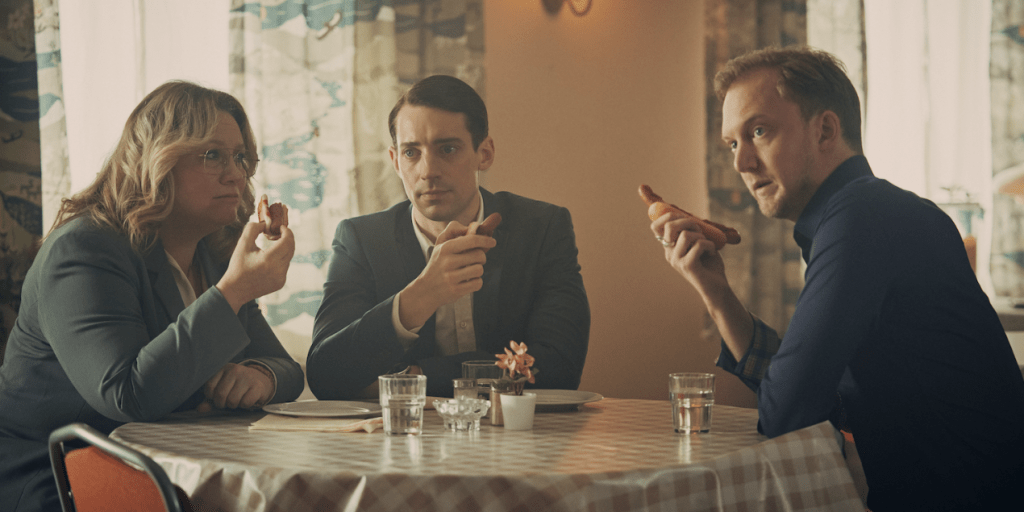
Kaj (Christoffer Nordenrot, right) sits with Jonas (Adam Lundgren, middle) and Ingela (Maria Sid, left).
Image credit: © 2023 Netflix, Inc.
Kaj is portrayed as somewhat overenthusiastic, overly involved, and a bit of a blabbermouth when it comes to keeping secrets (as was his and Jonas’s attempts to keep their Backmann-Kroon business betrayal on the down-low – Kaj couldn’t stop talking about it). He constantly attempts to seem cool by speaking in the ‘trendy’ Swenglish dialect – AKA getting English sayings comically wrong. From this, it can be inferred that he is likely one of the younger members of the group, or at least, the most up-to-date with the times (‘no-one says YOLO anymore’). He has a desire to be seen as fashionable and hip, looking especially towards Jonas for approval.
Kaj is rarely ever seen alone – he’s always with another member of the municipal group, most usually Jonas or Ingela, though before his death he was seen hanging out with Annette (Cecilia Nilsson). There might have been a few seconds where he was standing away from the group, but even then, it wasn’t like he was doing anything by himself. The Kolarängen group gives him a clear sense of belonging; he knows who he is, and what boundaries he can push, in that crew. His dependence on them, and thirst for fame (both internet, and to do with Backmann-Kroon), leads him to places that all other city planners wouldn’t go to with a gun.
So, now we have those basic personality traits out of the way, we can begin to connect them (among other things) to the main reason as to why I’m writing this article – the unavoidable bird imagery and motifs that follow Kaj everywhere.
The biggest pieces of evidence from the above are his Swenglish talk, and his crowd (well, flock) behaviour. As mentioned, Kaj repeats English phrases he’s likely heard online (‘ask not what you can do for your [country]’/’player’/’without content, who are we really, as a group?’/‘bro’). This is a form of mimicry. He doesn’t necessarily get the deeper meaning of what he’s saying; he’s just saying those things because it makes him seem socially integrated and up to date. When people laugh with him about it, or others speak English, it gives him a clear sense of satisfaction. He has done his job as the joker, and gets to stay respected and liked within his flock.
On the topic of mimicry, it is quite a unique thing in the avian world for a bird to ‘mimic’ things in order to bond better with a group. This is a behaviour distinctive to the corvid family of birds (ravens, crows, jackdaws, etc), who pointedly repeat things to one another to bond and navigate their environments (source: Corvid Research). The bird from this family that Kaj is most similar to is the jackdaw, and it is painfully clear to see once you put two and two together through a scene near the start of the movie.
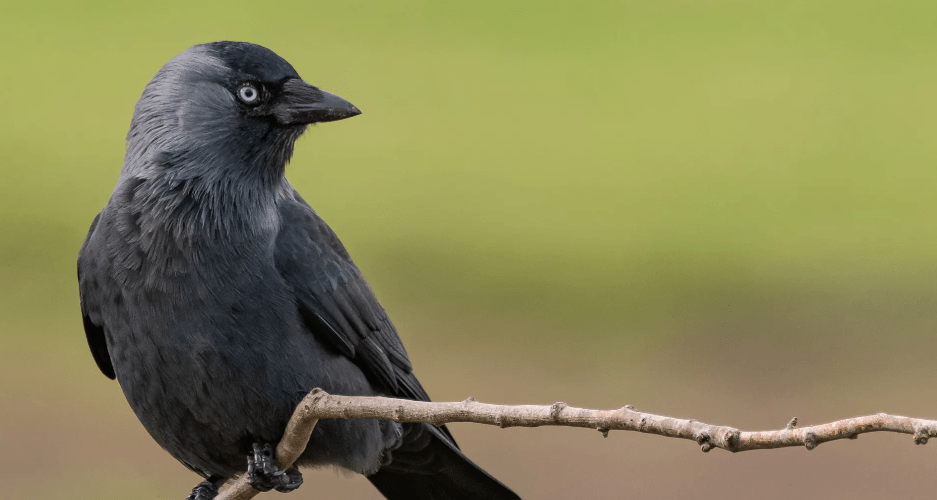
Image credit: RSPB.
When the municipal group enters the guest house, and are given their keys by Jenny (Lola Zackow), Kaj saunters up to the counter, rings the bell multiple times, and crows out ‘Ka-Ka-Ka-Ka-Kajan!’ – not only does the word ‘kajan’ mean jackdaw (as a definite article) in Swedish anyway, but the dinging of the bell is an example of stimulus and response (most likely through positive conditioning, in which Kaj has learnt that making noise and offering a smile attracts attention to himself). As for the ‘ka-ka-ka’, it can be inferred as one, or a mix, of a few things:
- A territorial call, which makes sense, seeing as he just got handed the keys to his room (nest).
- He’s playing with his own name in the same way a jackdaw (or other corvid) plays with the sounds they’ve learnt to mimic. It’s specifically designed to announce his presence to the flock (bonding with them)
- It’s a reference to how jackdaws ‘laugh’, making a sharp, metallic ‘kya’ sound.
- In the wild, jackdaws use their cries to maintain group cohesion when travelling. By vocalising in this specific way, Kaj is making sure the rest of the group is still behind him; them not reacting to it confirms this is a common event.
Speaking of the territory and the room, it’s worth noting that Kaj shares a room with Jonas (the person he seems closest to as is), which leads me onto another point. Pair-bonding, and also the fact that Jonas’s name is bird-related, too. Although my previous article focused on Jonas’s connection to Jonah (biblical), Jonas, as a name, is a direct Hebrew translation of ‘dove’. It is incredibly fascinating to me how both of the secondary antagonists who work together are named after avian species – and such different ones, at that. Whilst I have a specific post lined up specifically about the tragedy and the dynamic subtext of these two men, their angst is also unavoidable in this context.
Jonas and Kaj are almost always seen together. In fact, the first few lines from the film are said (sung – another bird pointer) by them together. They share their room together at the retreat. They are always standing/sitting by or opposite one another. They are seen close by each other in a flashback. They win the raft-making activity together, they walk by each other all the way back to the retreat, and when Kaj dies – surprise, surprise, it’s just after Jonas leaves him to talk to Lina, and leaves him with Annette instead of his constant company.
It is known that jackdaws pair-bond (mate) for life. This is clearly what Kaj has done with Jonas. He constantly trails after him with some sort of need for attention and validation – on his side, Kaj views Jonas as his equal (especially concerning their betrayal of the rest of the group). With the Backmann-Kroon plan, the idea was that Jonas and Kaj would leave to crumbling Kolarängen business venture to Ingela and the others, and join the B-K workforce in highly-paid executive positions. Kaj was on board for the entire thing. He was excited to talk about it with Jonas, clearly seeing a future for them both at this prestigious company. Kaj wanted to follow Jonas for the rest of his (business) life.
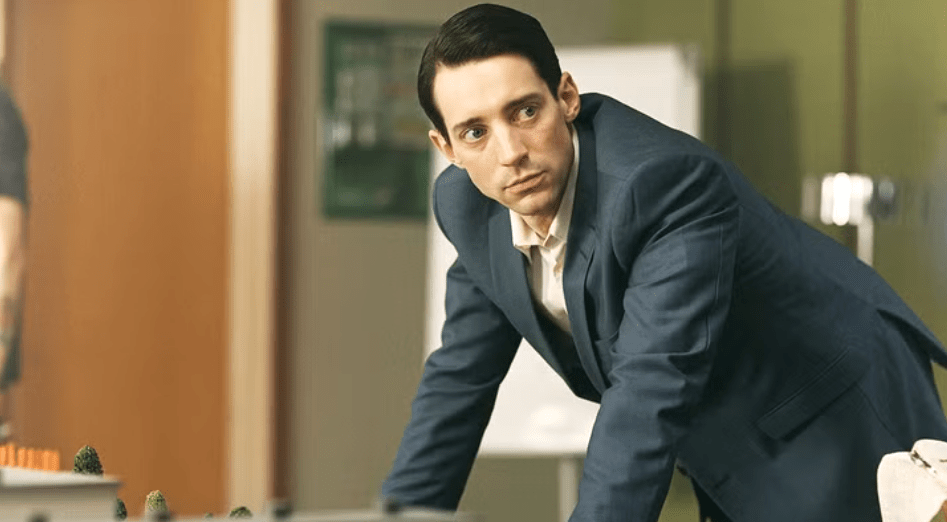
Image credit © 2023 Netflix, Inc.
Meanwhile, whilst doves are famously shown as the symbol of monogamy, there are rare occasions where they will only mate for one season, and move onto other partners after. Applying that to Jonas’s behaviour with Kaj, Jonas only needed a partner-in-crime for the project (seemingly just for forging a signature). There was no indication that Jonas was thinking about Kaj in his future. He didn’t even seem to care that he died after returning to the retreat.
The dove and the jackdaw dynamic is also a recognised fable. Aesop’s ‘The Jackdaw and The Doves’ highlights a seemingly similar situation. In the cautionary tale, the jackdaw dyes itself white to become part of the doves’ group. The doves let it stay with them for a few days, until the jackdaw starts being loud and can’t hide its true nature anymore. It is the literary version of Kaj rambling about the Backmann-Kroon plans to Jonas, and Jonas basically telling him to shut up. I think it’s at that moment that Jonas realises that this business relationship is not going to work out.
Kaj: But… the standard at next year’s conference will be higher, right? […] I mean, I heard that Backmann-Kroon flew their entire crew down to Dubai for theirs.
Jonas: Ah, ah, shh, shh, shh. Please. Don’t talk about that too much. Until it’s official.
Kaj: Ah. Okay. […] But… but it will happen, right?
Jonas: [scoffs] Of course it will. [Whistles].
It’s also about their outward appearances – their main outfits seem to reflect the birds they’re named after. Kaj wears a dark shirt, and Jonas wears a white one. On the topic of appearances, Kaj also wears a silver chain and rings. Something sparkly, and completely out of place in a professional setting, but it clearly means something to him to constantly be wearing them. Corvids (like jackdaws) famously love and collect shiny things. The chain and rings Kaj wears could be a reference to this behaviour.
Back to Kaj’s own behaviour, there is one more thing I’d like to mention, particularly in the context of Sweden itself. There is an idiom – ‘full som en alika‘ – meaning ‘as drunk as a jackdaw’. With all of the aforementioned points cementing that Kaj is basically a personification of a jackdaw, it should come as no surprise that this phrase seems to relate to him directly. Kaj is often seen with a beer in his hand; carrying them to the cabin, offering Jonas one, drinking in the hot tub. He dies mid-drink. His ‘drunk as a jackdaw’-ness was what got him killed. His sense of awareness was lowered, and he mistook the killer wielding a deadly boat motor as Jonas (his pair-bond, trusting him completely) simply playing a practical joke.
In conclusion, I think it is fair to say that Kaj is – purposely or not – an extremely unique take on a comic relief character. Having his ‘tropes’ be linked to bird behaviour instead of clichés was something fascinating to look at and write about. It’s certainly something I’ve never seen before or since.
 ira overanalyses
Leave a comment