Backrooms (directed by Kane Parsons, who also posted the original backrooms videos to YouTube based on the creepypasta of the same name) came out four days ago. It is currently smashing box office targets, and broke five records on its opening weekend alone. Parsons is now the youngest ever director to have a global #1 film. This is a monumental achievement, and this article hasn’t been made to besmirch that.
This is just my opinion – a phrase that doesn’t seem to hold much power in the film world anymore. I have seen comments all over Instagram, Tiktok, and Reddit claiming nonsensical, demeaning things along the likes of ‘if you didn’t like the film, you don’t get deep messages’, or ‘if you didn’t like this film, it’s not for you’. Other users have even said that people who didn’t like this film ‘have short attention spans’, or are ‘newgens/larping‘ (two new slang words which once again mean nothing important).
I, as a backrooms fan myself, went to see the film yesterday. I have been into internet horror since 2021, at just fourteen years old. I started off with things like The Walten Files (made by Martin Walls), and those creepy VHS tapes portraying the darkest corners of Five Nights at Freddy’s (created by users like Battington and Squimpus McGrimpus, becoming popular around lockdown). I have also watched things like The Mandela Catalogue (Alex Kister), Gemini Home Entertainment (Remi Abode), and the infamous black-and-white film, Begotten (E. Elias Merhige, 1991).
And in terms of horror films with a ‘message’, but actually a good watch that won’t leave you checking your watch for the first hour: The Conference (Patrik Eklund, 2023), Bird Box (Susanne Bier, 2018), and Us (Jordan Peele, 2019). I can and have watched horrors that are ‘slow’ and allegorical.
(Spoilers from this point on)!
Backrooms just didn’t do it for me. I so badly wanted to continue my ride on the yellow-hallway hype train, but I just can’t justify a continued journey when the film was so… underwhelming. The acting was good (of course it was, have you seen how many acting awards Chiwetel Ejiofor has?), but the characters just weren’t likeable. Like, at all. And I know that in a horror film that’s not exactly a top priority, and sure, maybe it does make the characters more ‘human’ – but the issue for me is, if I can’t like them, I can’t become attached, and I lose interest in them. Ultimately, I don’t feel anything when something happens to them, so the film loses its immersiveness and any emotional impact it would’ve had immediately.
The first fifty minutes introduces us to the boring, washed-up, and morally dubious character of Clark (Chiwetel Ejiofor himself) after a prolonged opening scene of a lost worker in the backrooms being ‘chased’ (read: slowly pursued at walking pace until the last few seconds) by ‘something’. It was less tense, more ‘can something actually happen now, please’.
Anyway, back to Clark. Most of the first half of the film focuses on how sad and lonely his life is, in an attempt to get us on his side and to feel for him. We see him have therapy with a lady named Mary (Renate Reinsve), and learn that Clark’s wife kicked him out of the house for coming home drunk – from work? Going to the pub or a bar isn’t mentioned. Did he buy drinks and have them in his car? Isn’t this breaking the law? I’m already doubting this man’s moral backbone and disliking him – and presumably screaming at her (as he acts out the incident in the therapy session with Mary) that she’s a failure, she’s fat, does nothing, and he has to pay for everything whilst she’s at university learning how to become a lawyer.
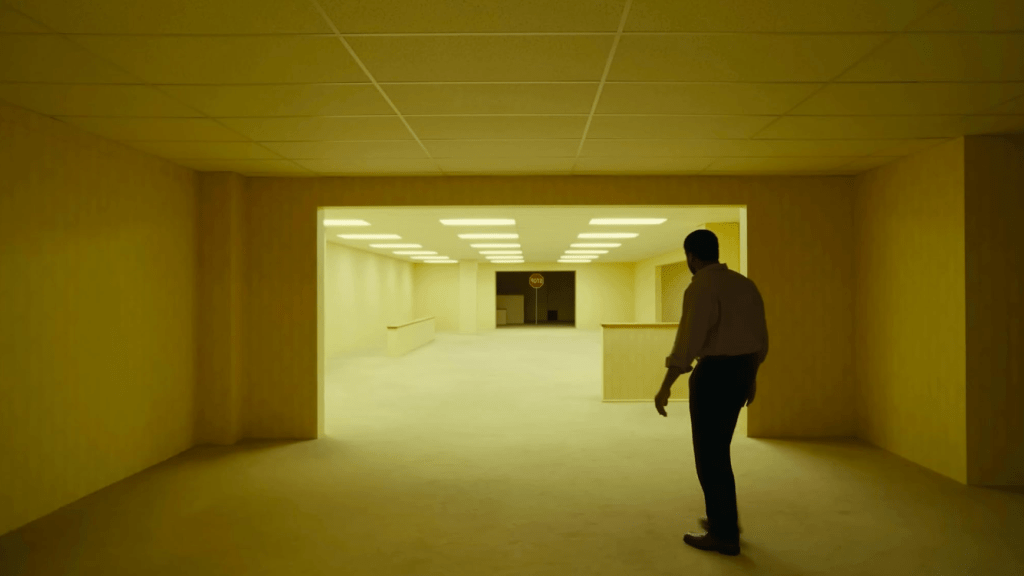
Image credit: IMDB, 2026.
Okay. Okay, okay, okay. I can see how people would initially be on his side. Clark has a dead-end job running a furniture store which is seen to have… a total of no customers over the course of the film. Ouch. That sucks for him, and I understand his frustrations with his wife not actively bringing in any money. In the therapy session, Mary clearly wonders if it’s projection, and when she’s acting as Barbara (the wife), she rebuts ‘just because you didn’t become an architect’. This makes Clark insanely defensive, and he loses it, resorting to calling Barbara names and pointing out the worst parts of her personality and physical appearance. Okay, now he’s just a jerk. You could’ve just had an adult chat about this. Maybe you already have (which is implied to have happened – or at least, they attempted to – multiple times), but still, there’s no need to call your wife (who you’re meant to support) ‘fat’ and ‘lazy’ and resort to aggressively swearing at her.
Off the bat, this guy has some issues, and he’s a massive asshole. What’s likeable about that? Anyone who relates to his actions at this stage or has acted like this towards their own partner would cause me concern. It’s fine to be frustrated, but acting like that is just insanely out of order. Towards the end of the film, Mary blurts out what the sane group of us is thinking – ‘she didn’t leave you because of your anger […] she left you because you can’t take accountability […] something wrong with you? It’s the world’s fault’. And she’s right. Trying to talk to someone who always acts as the victim is so mentally exhausting. Clark is ridiculously emotionally immature and always does things to serve himself. He’s painful to watch.
The other main character – Mary herself – is equally as annoying. Her plotline, whilst Parsons likely intended it to be ‘deep’, is just convoluted (like the most part of the film). I know people say ‘it’s good to leave things open’, my opinion is, ‘no, it’s not’. Especially when Mary is such an important character in this movie. Flashbacks are used to show her past as a locked-up child kept inside by her mentally unwell mother (though it took a couple of flashback sequences for me to realise this was the case, which it shouldn’t have). The film can’t decide if it wants to spoon-feed us exposition through tiring and obvious dialogue, like in the therapy sessions, or say nothing meaningful at all, like with the flashbacks. Why was the mother so scared? How did Mary get out and live a normal life? I just hate that the film spent more time pandering to Clark’s miserable point of view than Mary’s reasons for doing what she does (it’s presumable she did psychology or therapy at a license level because of her mother – but if her mother was so sick, where did she get the money to do it from?).
Another thing I can’t stand about Mary, which isn’t necessarily her herself, but more the tropes tied to her, is the amount of falling over. In horror films, it’s an automatic eye-roll moment. It’s overplayed, predictable, and just downright annoying. It’s nitpick-y compared to the rest of the criticisms I have, but I’ve seen this in so many movies that it just starts to get annoying – instead of enjoying the thrill of the chase, you’re shouting ‘oh my god, just get up!’ – like in The Conference (as much as I love it), and The Strangers: Chapter One (dir. Renny Harlin, 2024). When people have brought up the same issue in comments, users reply with things like ‘it’s realistic, though, if you’re that scared and being chased by a monster’. Look, I’ve suspended my belief for long enough to believe the monster exists in that film. That thing isn’t realistic. And characters make other dumb decisions in horror films which an average person wouldn’t do, so please, please, please stop the tripping trope.
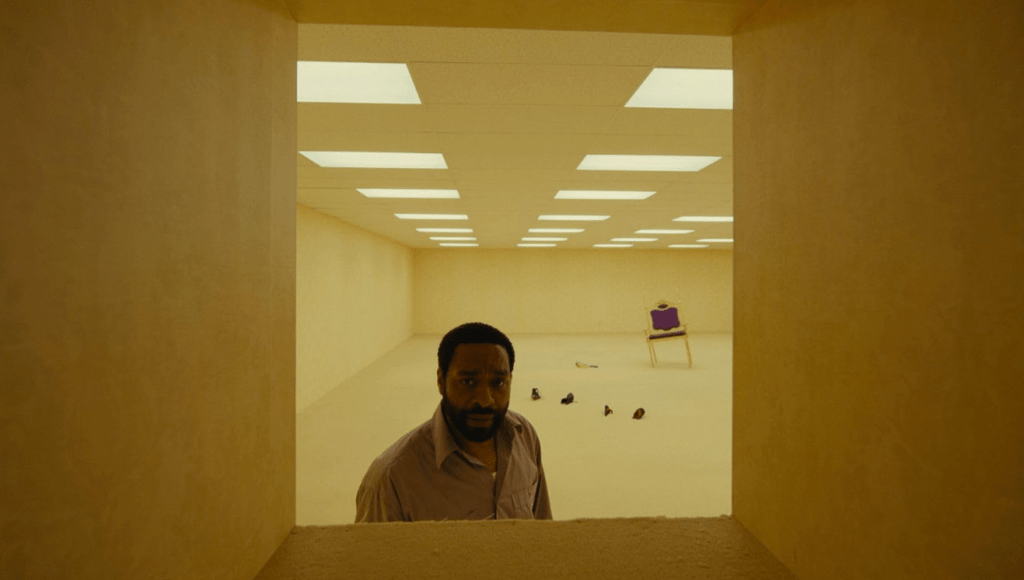
Image credit: IMDB, 2026.
Moving onto the actual ‘message’ of the movie, there’s some debate over it, but the majority concensus is the backrooms (and the monster version of Clark) are manifestations of his bitterness. He can’t change, so he’s trapped in these feelings of resentment and stagnation.
… Okay. Pretty deep for an internet horror series that is a mix of sci-fi and alien/body horror. The point I’m trying to make, and the point the film missed, is that the backrooms are just… there. They’re this meaningless, strange, liminal version of our world. There is no why. Of course, scientists and government agents still investigate them, but it’s treated as more of a supernatural, alien entity rather than an emotional, allegorical thing. The backrooms are better just as an internet horror concept, left up to the viewer’s imagination. More and more backrooms ‘levels’ have been made by fans, with their own entities and aesthetics. The VHS tape made by fans on YouTube and Tiktok honestly make me feel so much more fear and intrigue than the movie did at any point.
I think that most modern horror films based on games and internet folklore are simply unnecessary. Five Nights at Freddy’s (Emma Tammi, 2023) was bad, Slender Man (Sylvain White, 2018) was bad, and now we have Backrooms, which in my opinion, was… bad. There seems to be this obsession with making things marketable, whilst simultaneously trying to be ‘deep’. Not everything needs a deeper meaning. This doesn’t not make you a critical thinker. Perhaps you just enjoy the speculation of the original media without all the glamour trying to hide the plot holes.
 ira overanalyses
Leave a comment